













Transaction Center
Time to bring it home. Find zipForm®, transaction tools, and all the closing resources you'll need. Except for the champagne — that's on you.
View the latest sales and price numbers. Find out where sales will be in upcoming months.
Get a roundup of weekly economic and market news that matters to real estate and your business.
Gain insights through interactive dashboards and downloadable infographic reports.
All Shareable Reports All Interactive DashboardsCatch up with the latest outreaches and webinars by the Research and Economics team.
C.A.R. conducts survey research with members and consumers on a regular basis to get a better understanding of the housing market and the real estate industry.
California Model MLS Rules, Issues Briefing Papers, and other articles and materials related to MLS policy.
Looking for information on how to file an interboard arbitration complaint? You've come to the right place! Find the rules, timeline and filing documents here.
Summaries and photos of California REALTORS® who violated the Code of Ethics and were disciplined with a fine, letter of reprimand, suspension, or expulsion.
The most recent edition of the Code of Ethics and Standards of Practice of the National Association of REALTORS® along with other important links to NAR information.
The California Professional Standards Reference Manual, Local Association Forms, NAR materials and other materials related to Code of Ethics enforcement and arbitration.
Designed to expand housing access, Proposition 37 proposes a $25 billion state bond program providing eligible middle-income homebuyers with fixed-rate second mortgages covering up to 17% toward the purchase of newly constructed homes.
C.A.R. advocates for REALTOR® issues in Washington D.C., Sacramento and in city and county governments throughout California.
CREPAC, LCRC, IMPAC, ALF and the RAF comprise C.A.R.'s political fundraising arm.
The RAA: Protecting REALTORS® and Homeownership REALTOR® Action FundC.A.R. Senior Vice President of Government Affairs Sanjay Wagle sits down with California Insurance Commissioner Ricardo Lara to discuss the current state of California’s insurance market,
Learn how you can make a difference, by getting involved yourself or by passing along valuable information to your clients.


|
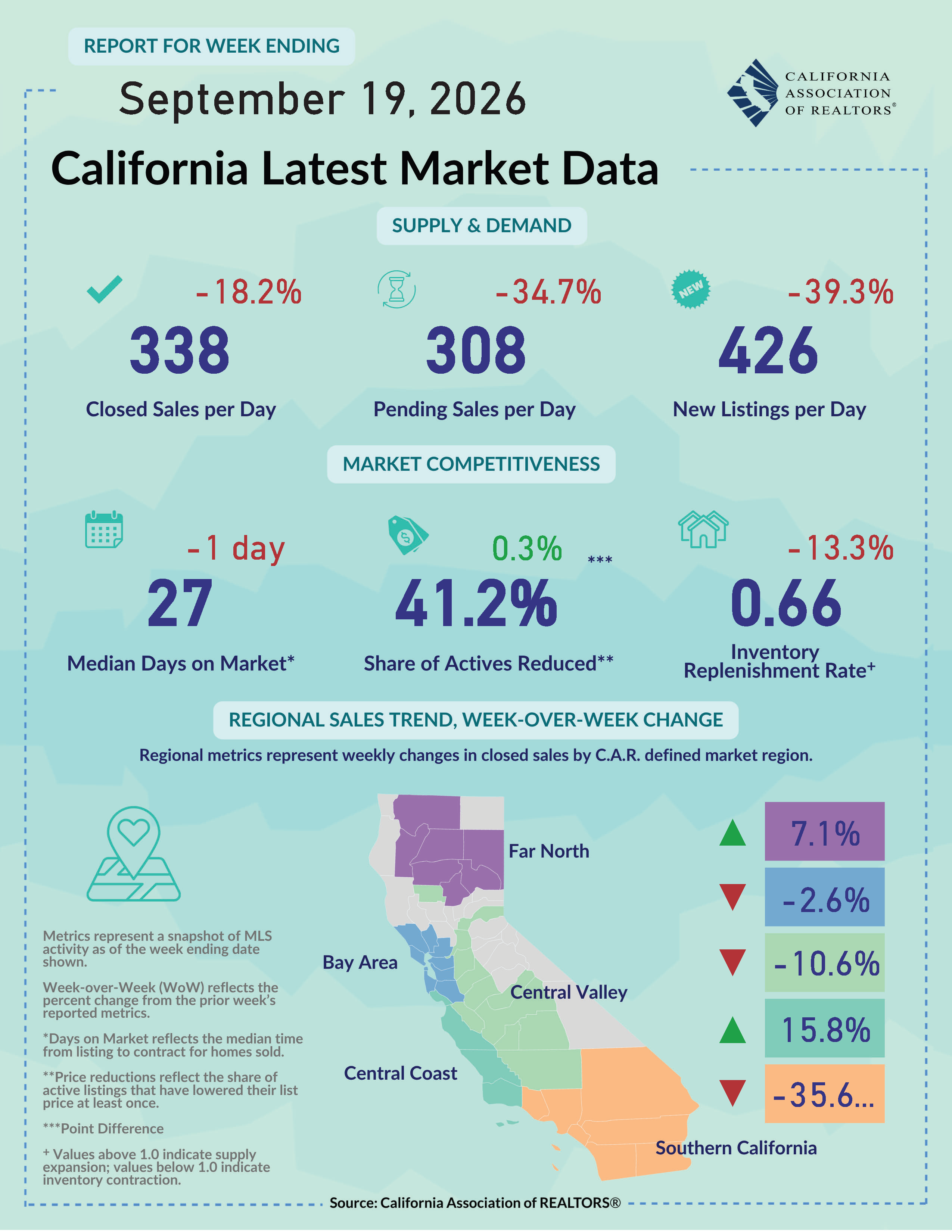
September 21, 2026 - California’s housing market remained resilient in August, with sales and prices edging higher after a softer July, while latest data on consumer spending suggested that the economy is holding up better than expected. However, the outlook for the rest of the year is still unclear as geopolitical tensions persist. Elevated mortgage rates, lingering inflation, weaker pending sales, and softer builder sentiment will create more headwinds for both buyers and sellers in the coming months. As a result, market activity could be restrained in the third and fourth quarters, even if year-to-date conditions remain modestly better than last year. Fed approves rate hike, signals more to come before the year-end: The Federal Reserve raised its benchmark interest rate last week by 25 basis points (bps) to a target range of 3.75%-4.00% and signaled that another increase remain a possibility later this year. The rate hike is part of an effort to combat inflation brought on by a strengthening economy, rising energy oil prices and other factors. The Committee noted that consumer spending remains solid, business investment is robust, and unemployment has changed little, but emphasized that inflation is still running above its 2% target. The first rate-increase in three years should help bring inflation back to the Fed’s objective more quickly but additional tightening may be necessary later this year. Following the announcement, treasury yields initially remained elevated near multi-year highs, but the 10-year yield fell modestly the day after as markets digested the central bank’s latest decision. Mortgage rates moderated slightly by the end of last week, but the average 30-year fixed mortgage rate remained near its 20th-month high, according to Mortgage News Daily data. Sales finished the buying season on a positive note but outlook is murky: California home sales bounced back in August following a pullback in July and remained above their year-ago level for the fifth consecutive month. Existing single-family home sales increased 2.4% from July to a seasonally adjusted annualized rate of 269,620 units and rose 1.4% from the revised 265,780-unit pace recorded in August 2025. Pending home sales weakened last month though, with a decline of 1.9% from the prior month and 8.5% drop from a year ago. The annual decline reversed the brief rising trend in the past two months and was the largest year-over-year dip since September 2023. With mortgage rates surging in the past few weeks, housing market conditions will face more affordability challenges in the months ahead and sales are expected to soften in the fall and the winter months. Home prices rise again from last year but more downward pressures expected in the near term: California’s statewide median home price rebounded in August, climbing back above the $900,000 benchmark last month. The statewide median increased 1.6% from the prior month to $901,420, exceeding the long-run average increase of 1.2% typically observed between July and August, but falling short of the 2.2% average gain recorded over the past 10 years. On a year-over-year basis, the median price edged up just 0.1%, the smallest in the past four months. Looking ahead, higher borrowing costs and lingering economic uncertainty will create headwinds for both buyers and sellers in the remaining months in 2026. The year should still end with a slight increase in the statewide median price when it’s all set and done, but conditions could become less supportive for market fundamentals in the months ahead. Retail sales bounced back solidly in August after spending pulled back in July: U.S. retail sales rebounded with a better-than expected growth rate as discretionary categories provided strong support to the overall consumer spending growth, according to the latest report released by the Commerce Department. Sales at retail and food services last month increased 1.2% from July after dipping 0.5% in the prior month and recorded a 6.0% year-over-year gain over August 2025. The jump in retail sales was partly due to higher prices at the gas pumps, but total sales excluding sales at gasoline stations also increased solidly from a year ago by 4.9% in August. The resilience in consumer spending was most notable in miscellaneous store retailers with the category jumping 14% from last year, while sporting goods/musical instruments (10.7%), nonstore retailers (9.9%), and electronics (7.8%) also increased solidly from 12 months ago. While discretionary goods and services remained solid in the latest report, traditional grocery and essentials staple sectors have actually shown stalling growth. Consumers appear resilient for now, but future spending could be challenged if gas prices remain elevated and Americans’ budgets continue to be squeezed. Housing starts fall as multifamily projects plummet: U.S. housing starts fell again in August as mortgage rates rose and inventories remained high, according to latest data released by Commerce Department last week. Overall housing starts last month declined 2.6% from July to a seasonally adjusted annual rate of 1.275M, as multifamily starts plunged 22.5% month-over-month and slid 15.5% year-over-year. Single-family, on the other hand, bounced back solidly last month, with starts in August increasing 7.6% from the prior month and climbing 5.2% from the same month a year ago. For the first eight months though, single-family starts remained below last year’s level by 4.9%. Builders also pulled back on permitting activity, with overall permits issued dipping 2.7% from July, but improving from last August by 3.5%. With affordability continuing to constrain demand and new housing inventories stacking up, developers are putting projects on hold until the big picture clears up. Builder sentiment, released by NAHB/Wells Fargo, in fact, declined three points to 32 in September, reaching the lowest level in 12 months. The index’s measure of sales expectation in the next six months declined six points to 37, while the measure on traffic of prospective buyers stayed flat from the prior month at 23. The share of builders who cut prices in September increased to 38% from 35% in August, and 66% of them reported using sale incentives in September, up from 63% in the prior month. With mortgage rates hitting the highest levels in 20 months, building activity could slow further as developers remain cautious in the near term. Note: This summary report gets updated every Monday by 6:00 pm PST. Feel free to email us at [email protected] if you have any questions and/or feedback.
|
|